


Subscribe to our news Telegram channel Cryptoage and stay up to date with all the latest trends.
Mining, Airdrops, Trading, Guides, Technologies, Investments - it's all there!!!
Team Black Miner 2.45 brings Pearlhash to GTX 10 and RX 400: what old GPUs can still do
Team Black Miner has a new release, and this one is aimed squarely at old rigs. Version 2.45, published on November 1 at 19:02 UTC, adds CUDA and OpenCL support for Pearlhash, the algorithm behind Pearl (PRL), on cards that most Pearl miners had written off: NVIDIA GTX 10 series and newer, and AMD Radeon RX 400 and RX 500 series and newer.
What changed in 2.45
- Pearlhash on NVIDIA and AMD. The release notes name GTX 10 and later on the green side and RX 400/500 and later on the red side.
- Ergo support. The miner now also runs Autolykos v2 for Ergo (ERG) on both vendors. The notes call it "Octopus V2", but the README lists it correctly as Autolykos v2.
- Fixed statistics on older AMD cards. Temperature, power and load readings on older Radeons were wrong before; the fix changes what the console shows, not how much work the card does.
The developer fee stays at 0.5% for every algorithm. Two builds are published: a CUDA 12.9 archive and a package for Ubuntu 24.04 with CUDA 12.9 (version 2.44 shipped for Ubuntu 22.04). Details and downloads are on our Team Black Miner 2.45 release page and in the official release notes.
How fast the old cards are
The developer published sample Pearlhash figures together with the release. They are not independent benchmarks, and no power draw is given, so treat them as a rough guide to where each card stands.
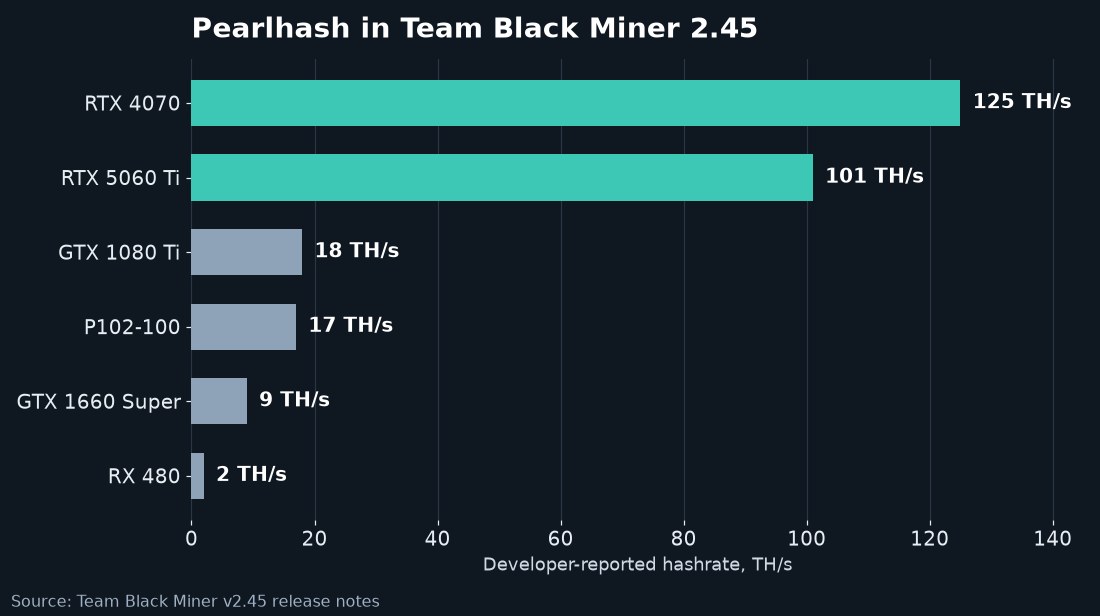
The gap is the story: an RTX 4070 at 125 TH/s does roughly seven times the work of a GTX 1080 Ti at 18 TH/s and more than sixty times that of an RX 480 at 2 TH/s. Pearl rewards matrix math on tensor cores, and cards without them can only brute force it. A mining-only P102-100 lands at 17 TH/s, close to the 1080 Ti it is based on.
Is it worth switching an old card on
Support is not the same as profit. Before you leave a GTX 1080 Ti or RX 580 running on Pearl, check three things:
- Accepted shares, not local hashrate. Run the card for a few hours on your pool and compare what the pool credits with the number in the console.
- Wall power. Measure the whole rig with a meter and set that against the daily payout at your electricity price.
- The FP8 fork. Pearl's planned PIP-3 upgrade moves mining to FP8 math and, as drafted, only accepts NVIDIA Hopper and Blackwell chips. Pascal and Polaris cards would drop out at that fork. As of the end of October the proposal is still a draft with no mainnet activation height, so nothing changes yet. We covered which cards are affected in our Pearl and Quantus FP8 fork breakdown.
How to start
The repository ships ready-made Pearl launch scripts for Windows and Linux: you replace the example prl1... wallet with your own and set a worker name so you can tell rigs apart on the pool. The README also describes Pearl and NockChain merge mining on LuckyPool, where both wallets are entered in one field joined by a plus sign. Keep your previous miner version and its config until the new one has proved stable on your hardware.