


订阅我们的 Telegram 新闻频道 Cryptoage,了解所有最新趋势。
挖矿、空投、交易、指南、技术、投资——应有尽有!!!
A Monero pool mined the chain's biggest block to store a music video and gave up 99% of the reward
A new Monero mining pool called XMR20 mined the heaviest block in Monero (XMR) history on 5 November and paid for it with almost the entire block reward. Block 3,799,494 was found at 04:20 UTC and contains only one transaction: the coinbase, the transaction in which the miner pays itself the reward.
That coinbase is 599,000 bytes. According to XMR20, about 598,000 bytes of it are a 21-second MP4 music video stored in tx_extra, the free-form data field of a Monero transaction. The project says the previous largest block on the chain was 569,375 bytes, in January 2021.
Why the video went into the coinbase
Monero nodes relay only up to 1,060 bytes of tx_extra, so an ordinary transaction carrying the video would never have reached the mempool. XMR20 bypassed relay by building the data into its own coinbase and mining the block itself. After the block, the pool said it had stopped mining for now.
What the record cost the miner
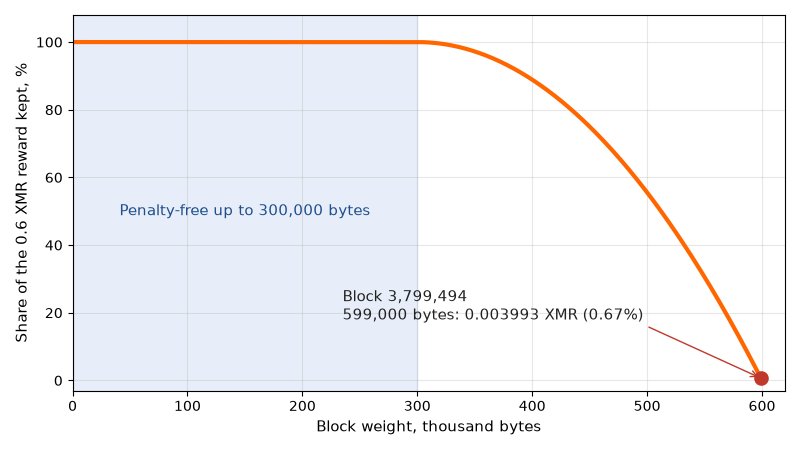
The block explorer shows a reward of 0.003993 XMR for block 3,799,494, with zero fees. A normal block currently pays about 0.6 XMR of tail emission, so roughly 0.596 XMR, or 99.3% of the reward, was never created. You can check the block on xmrchain.net.
This is not a fine imposed by anyone: it is Monero's standard dynamic block size rule. Blocks up to the effective median weight, which never falls below 300,000 bytes, get the full reward. Above it, the reward is multiplied by 1 − (weight / median − 1)². With a 300,000-byte median and a 599,000-byte block, that gives 0.6 × 0.006656 ≈ 0.003993 XMR, exactly what the miner got. At 600,000 bytes, twice the median, the formula drops the reward to zero.
What it means for XMR miners
- Nothing changes for normal mining. The block is valid, the network keeps running, and no update is needed for pools, P2Pool or solo setups.
- The penalty works as designed: stuffing blocks far beyond the median is extremely expensive for the miner, which is why pools normally keep blocks under it.
- The 1,060-byte tx_extra relay limit, added after the 2023 wave of Monero inscriptions, still blocks this kind of data in ordinary transactions. Only a miner willing to give up the reward can get around it.
- Your pool's block reward is still about 0.6 XMR plus fees. Check current XMR profitability for your CPU on the coin page before switching hashrate.