


Bitcube and the Avalon Home series: what a home Bitcoin miner can do this winter
Power Mining from Riga and Canaan have launched Bitcube, a palm-sized home miner for Bitcoin. It arrives just as the heating season starts and miner margins get thin, so it is a good moment to compare what a home setup can actually do with Canaan's Avalon Home line.
What Bitcube is
Bitcube was announced on October 21, 2026. It runs on Canaan's Avalon A3197 chip and delivers about 777 GH/s of SHA-256 hashrate. The device is powered over USB-C, connects over Wi-Fi and lives in a closed 74 × 74 × 80 mm case with a 2.73-inch touchscreen that shows hashrate, power use, temperature, best shares and the odds of finding a block. One tap switches between Quiet and Turbo modes. It supports both pool and solo mining. The press release does not state the power draw.
For Power Mining this is the first product built on chips supplied directly by the manufacturer. The company says most of its more than 25,000 earlier home miners were made from chips desoldered by hand from industrial machines.
How it compares with the Avalon Home series
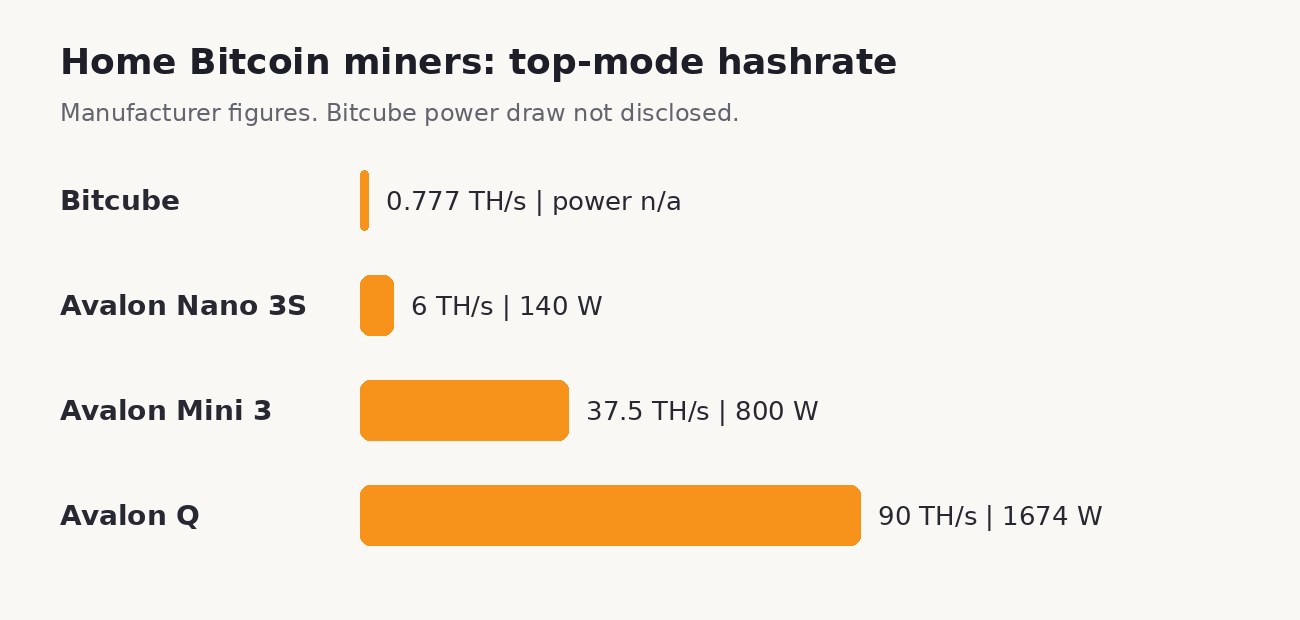
- Avalon Nano 3S: up to 6 TH/s at 140 W, three modes (3.1 TH/s at 66 W, 4.8 TH/s at 104 W, 6 TH/s at 140 W), 33-40 dB by Canaan's figures. The 140 W USB-C power supply is in the box, and ordinary phone chargers are not enough for it.
- Avalon Mini 3: 37.5 TH/s at about 21 J/TH, up to 800 W of heat, with a thermostat and Heater, Mining and Night modes. It is a room heater that mines.
- Avalon Q: 53 TH/s at 850 W in Eco, 80 TH/s at 1,414 W in Standard and 90 TH/s at 1,674 W in Super. Wi-Fi and Ethernet, 39-47 dB depending on mode.
Bitcube is clearly the entry ticket: its hashrate is about an eighth of a Nano 3S on high. Its pitch is size, silence and simple setup rather than income.
What the numbers mean right now
On November 1 the Bitcoin hashprice was $33.05 per PH/s per day, 19.1% lower than a month earlier. Network difficulty rose 5.54% on October 29 to a record 148.36 T. By simple arithmetic, 1 TH/s grosses about 3.3 cents a day at that hashprice before power and pool fees. That is roughly 20 cents a day for a Nano 3S on high and about $3 a day for an Avalon Q in Super mode, which draws around 40 kWh a day.
That is why home devices make the most sense in two cases: when the heat replaces an electric heater you would run anyway, as with the Mini 3 or the Q in winter, or as a solo lottery ticket.
Pool or solo
Small miners do sometimes win. According to Power Mining, a single Bitaxe running at about 1 TH/s found block 957,382 on Public Pool in July 2026 and received 3.138 BTC, and in April 2026 a NerdQAxe++ built by the company found block 945,601 on Parasite Pool. These are rare events, not a forecast.
If you want steady small payouts instead, point the device at a regular Bitcoin pool, for example EMCD (sign up). A miner the size of an Avalon Q earns regular pool payouts, while a Nano 3S or Bitcube is mostly used for solo mining.
Before you buy
- Check your circuit: Super mode on the Avalon Q draws 1,674 W, which is a heavy continuous load for a standard 15 A, 120 V line.
- Count the heat as part of the return: in summer the same watts only add to cooling costs.
- Look at efficiency in J/TH, not just hashrate: the Q in Eco mode is the most efficient of the Avalon Home trio.
Sources: Power Mining and Canaan press release, Canaan store, Altair Technology guide to the Avalon Home series, Maketo hashprice, Bitcoins News on difficulty.