


RandomX v2 explained: what XMRig 6.26 already supports and when Monero switches
Monero's proof of work is getting its first major revision since 2019. RandomX v2 is already supported by XMRig 6.26.0 (algorithm rx/2), it runs on Monero's test stressnet, and the code that would enable it on mainnet is under review. What it is still missing is an activation date.
What changes in RandomX v2
The update was merged into the RandomX repository on February 17, 2026. According to its author, it:
- increases the program size from 256 to 384 instructions;
- changes rounding mode (CFROUND) 16 times less often;
- mixes registers with 16 extra AES operations;
- prefetches the dataset two iterations ahead instead of one.
As a result, one v2 hash takes about 52.9% more operations than a v1 hash. The reasoning in the design notes is simple: modern CPUs such as Zen 5 got much faster, but RAM latency did not, so the algorithm gives them more work while they wait for memory.
Where things stand
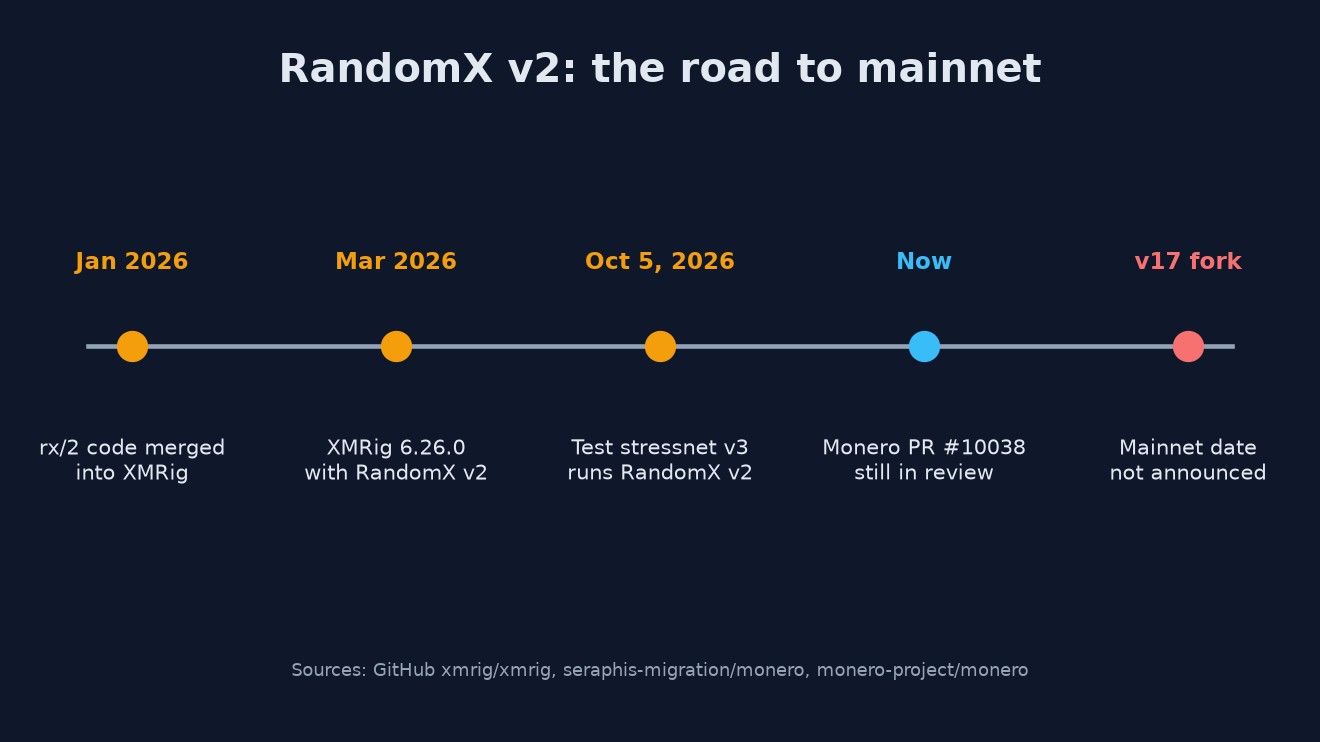
- March 28, 2026: XMRig 6.26.0 shipped with RandomX v2 support.
- October 5, 2026: the FCMP++/Carrot beta stressnet v3 forked at block 3,102,800 with RandomX v2 enabled, Monero Observer reports. A P2Pool v5.0 beta for the stressnet followed.
- Now: pull request #10038, which adds RandomX v2 to Monero's v17 consensus rules, is still open and marked as pending review.
No mainnet date has been announced. Mining XMR on mainnet still uses the current RandomX.
Early benchmarks: why lower hashrate is not a loss
The public XMRig benchmark already shows rx/2 results. They are useful as a first look, but the samples are tiny.
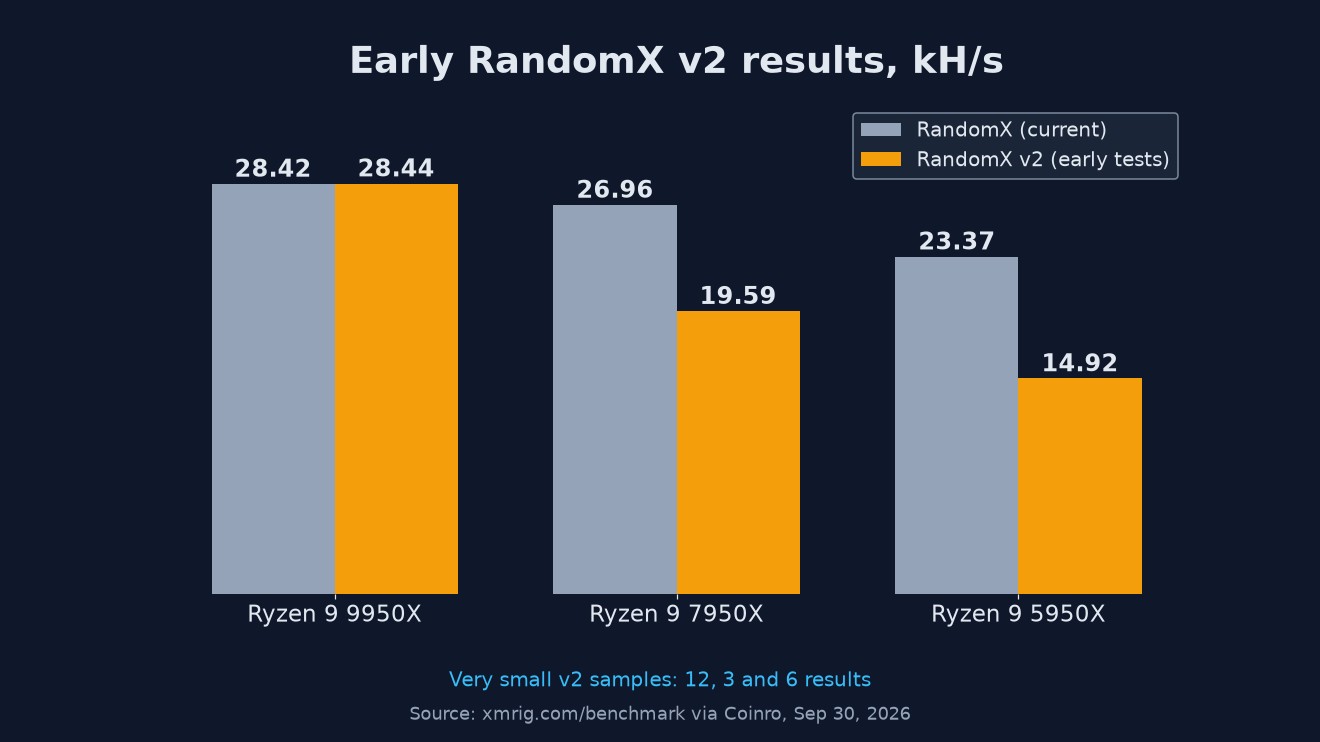
On xmrig.com the best rx/2 results with 32 threads are 28,441 H/s for the Ryzen 9 9950X (12 samples), 19,589 H/s for the Ryzen 9 7950X (3 samples) and 14,918 H/s for the Ryzen 9 5950X (6 samples). Older Zen generations lose more relative to v1.
Comparing raw hashrate across versions is misleading, though, because a v2 hash does more work. In the developer's own tests, a 9950X at 285 W kept 98.55% of its v1 hashrate while doing 150.72% of the work per joule; at 100 W it kept 87.11% of hashrate and 133.23% of work per joule. When every miner switches at the fork, network difficulty adjusts to the new hashrate level.
What CPU miners should do now
- Update to XMRig 6.26.0 or newer so you are ready for the fork.
- Test your rig with xmrig --bench=1M --submit -a rx/2 to see where it lands and to help the public dataset.
- Keep mining mainnet on the current algorithm until the v17 fork is scheduled, and ignore pools or tools that advertise "RandomX v2 mainnet" before that.