


Qubic BPP-9000 explained: how neural-network mining and Ant Colony Mining work now
Qubic no longer pays miners for grinding hashes in the usual sense. Its current mining algorithm, BPP-9000, asks miners to find tiny neural networks that reproduce the hour-by-hour direction of Bitcoin over one year of historical data. Since epoch 228 that search runs inside a framework called Ant Colony Mining, where accepted results build on each other. Here is what changed, how a solution gets accepted and what it means if you point hardware at Qubic.
What BPP-9000 actually asks for
Each hour of Bitcoin's price history becomes one label, up or down. A network produces its own stream of up-or-down calls, and the score is the number of hours it gets wrong, so lower is better. The graded window is 8,760 hours, one full year. Starting with epoch 235 that year begins on July 1, 2025; earlier epochs used a year starting January 1, 2025.
The networks get no price input at all. Each one has 64 neurons, and every neuron holds one of three states: 0, 1 or unknown. A neuron reads three others, which gives 27 input combinations, and carries its own rule table for each of them. A miner can change only three things: the start state, the wiring and the rule tables.
- One neuron acts as a clock. The scorer reads an answer only when it leaves the unknown state, so the network decides how long to think about each hour.
- A second neuron gives the call. If it is still unknown at that moment, the hour counts as wrong.
- A network that never answers fails: the scorer gives up after 100,000 ticks.
Since epoch 233 there is a sliding window. When a network passes the error threshold, the window moves forward one hour and the network is scored again, for up to 168 hours. Results are ranked by how far the window moved first, and the number of misses only breaks ties.
From a mutation to an accepted solution
A miner never starts from scratch. It takes an existing parent network, wanders away from it first and then climbs, keeping every change that does not make the score worse. The candidate counts only if it strictly beats the parent; a tie is rejected.
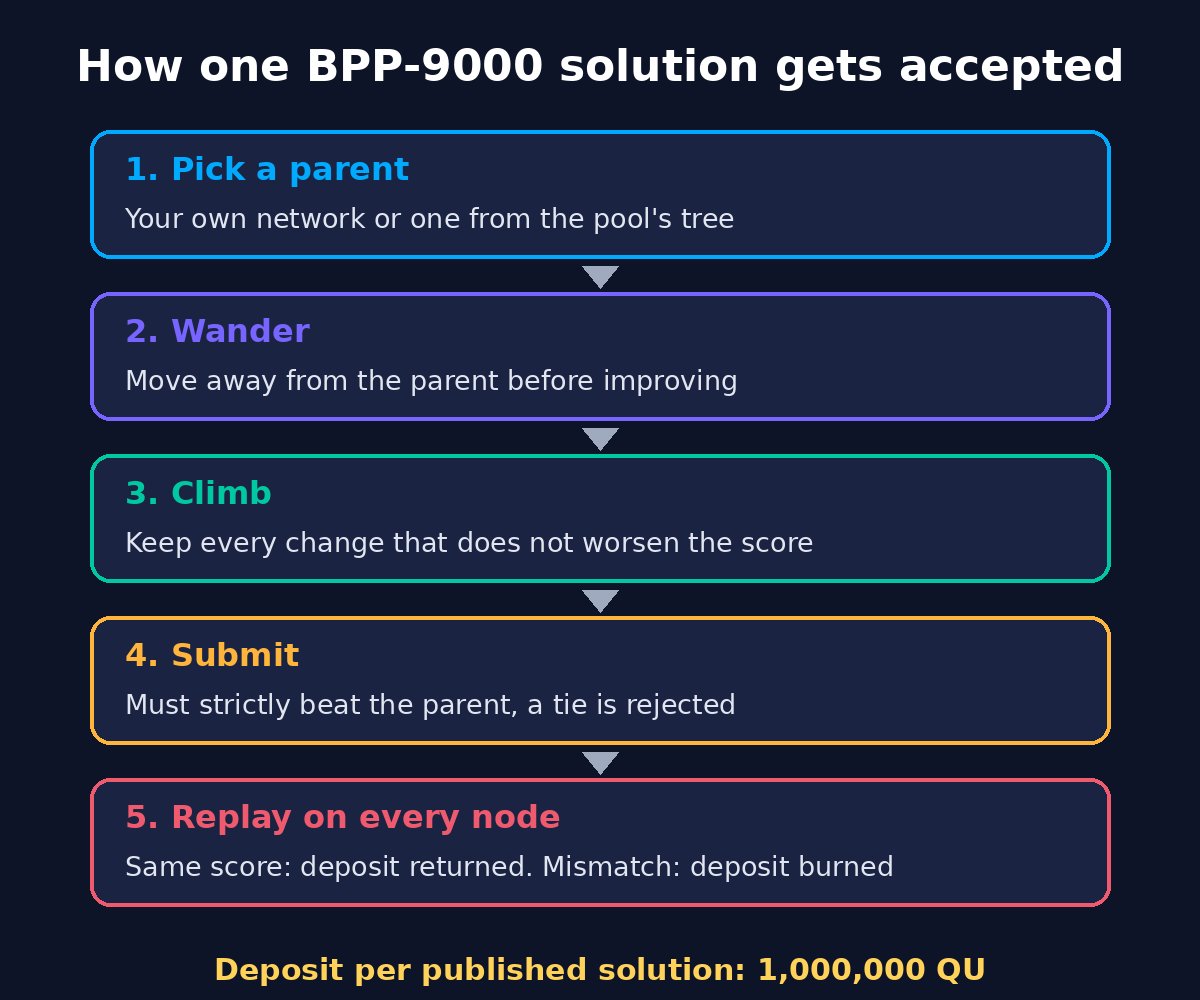
Every node can check the work itself, because BPP-9000 is fully deterministic. A submission carries a short recipe, and any node holding the parent replays it and gets the same score bit for bit. The computor that publishes a solution puts up a refundable deposit of 1,000,000 QU. If the replayed score matches the claim and the acceptance rules pass, the deposit comes back. If not, the result goes unranked and the deposit is burned.
Why the pool matters more than before
Each mining identity grows its own tree of solutions during an epoch, starting from a virtual root. For pools, that tree belongs to the computor the workers mine for, so one worker's accepted improvement becomes the starting point for everyone else on that pool. A solo identity starting from the root has an extra gate: it must clear the epoch's error threshold, which defaults to 4,350 misses in the current code.
Ranking also changed in spirit. Each identity is ranked by its single best network, so a pile of average submissions does nothing for its position. Miners used to be paid for producing the most answers; now they are paid for producing the best one. Epochs last a week, and at the end of each one nodes write out up to 676 best networks, one per computor seat. The next epoch starts every tree from a fresh root.
Activity in the current epoch
Independent on-chain data from the qubic.lt analytics page shows how fast the search has grown. As of November 2, 10:02 UTC, epoch 237 had 5,439,046 solutions from 1,584 submitters. The whole of epoch 236 ended with 2,539,486 solutions from 977 submitters, and epoch 235 with 6,579,460 from 1,262. Scores are not comparable across epochs, because the task file, the window and the graded year all changed along the way.
What to check before you mine
- Client version. Qubic-li Miner 3.11.0.0 was the mandatory update for epoch 236, and version 3.12.0.0 came out on November 1. Stay on the latest build.
- Task file. Pool and miner developers should match the task file against the epoch context hashes. A mismatch forfeits the deposit on every submission.
- Anchor ticks. Solutions must be anchored on ticks that contain data, otherwise they are rejected and the deposit is lost.
- Pool choice. Because the tree is shared, a pool such as qubic.org lets your work build on results found by other workers in the same epoch.
What the score does not mean
The Qubic team itself warns that a low BPP-9000 score is not a trading signal. The networks receive no market data, every graded hour comes from a fixed historical file, and testing a huge number of variants on one history makes a lucky fit likely. Treat the score as a measure of how well the search is going on this benchmark, not as a Bitcoin forecast.