


Subscreva o nosso canal de notícias Telegram Cryptoage e mantenha-se a par das últimas tendências.
Mineração, Airdrops, Trading, Guias, Tecnologias, Investimentos - está tudo aí!!!
Nvidia agrees to pay $290 million to settle claims it hid how many GeForce cards went to crypto miners in 2017-2018
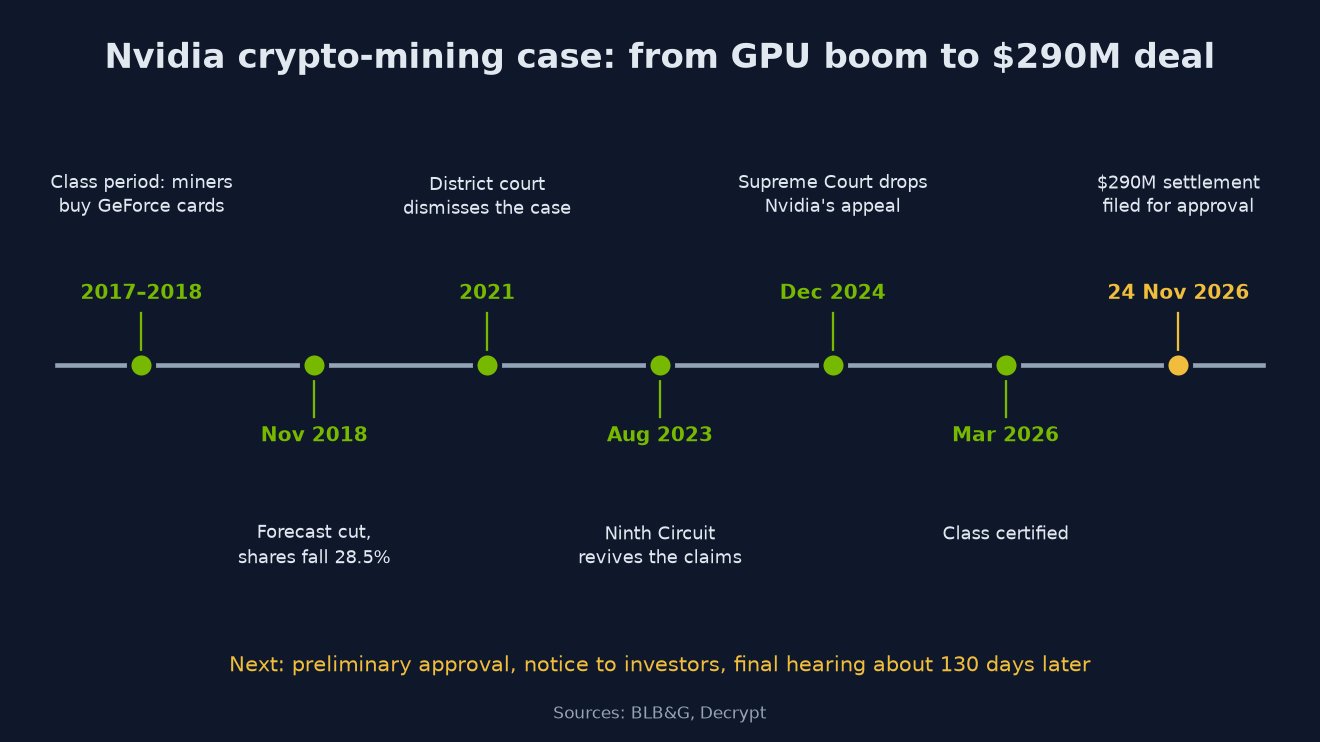
Nvidia has agreed to pay $290 million in cash to end an investor lawsuit over the crypto mining boom of 2017-2018. The motion for preliminary approval was filed on 24 November 2026 in federal court for the Northern District of California, according to co-lead counsel Bernstein Litowitz Berger & Grossmann. The deal is not final yet, and Nvidia denies any wrongdoing and admits no liability.
What the case is about
The suit, In re NVIDIA Corporation Securities Litigation, claims that Nvidia and CEO Jensen Huang misled investors about how much of the GeForce sales surge depended on cryptocurrency miners. Cards bought for mining rigs were booked as gaming revenue, so the volatile mining demand looked like steady demand from gamers.
The class covers investors who bought Nvidia stock between 10 August 2017 and 15 November 2018, the peak of the last big GPU mining wave. The GeForce lineup of that period was the GTX 10 series, with cards such as the GTX 1060 6GB, GTX 1070 and GTX 1080 Ti in many mining rigs. An analysis commissioned by the plaintiffs estimates that Nvidia understated its crypto-related GPU sales by about $1.1 billion over that stretch. When the crypto market fell, Nvidia cut its quarterly revenue forecast in November 2018 and its shares dropped 28.5%.
Seven years in court
- 2021: the district court dismissed the case.
- August 2023: the Ninth Circuit revived the claims against Nvidia and Huang, while claims against two other executives, including CFO Colette Kress, stayed dismissed.
- December 2024: the U.S. Supreme Court heard Nvidia's appeal and then dismissed it without ruling on the merits.
- March 2026: the court certified the class.
- September 2026: both sides accepted the $290 million figure proposed by mediator Layn Phillips, a former federal judge.
The numbers behind the deal
- The plaintiffs' damages expert put the maximum the class could win at trial at about $2.06 billion, so $290 million is roughly 14% of that.
- The plaintiffs' lawyers plan to ask for up to 21.4% of the fund, about $62 million, in fees.
- If approved, it would be the seventh-largest securities class action settlement in the Northern District of California since 1995.
- The lead plaintiff is the Dutch pension fund Stichting Pensioenfonds PGB.
What it means for miners
The money goes to shareholders, not to people who bought graphics cards. A miner who also bought Nvidia stock between 10 August 2017 and 15 November 2018 may be part of the class. Under the proposed schedule the court first decides on preliminary approval, then investors get a notice with instructions, and the final hearing comes about 130 days later.
For GPU mining the case is mostly a reminder of how hard a mining wave can swing the graphics card market and a vendor's own numbers. In the next boom, in 2021, Nvidia took a different route: it limited Ethereum hashrate on many GeForce cards (LHR) and launched the separate CMP line for mining. The settlement is not related to this month's turmoil around Huang's brief removal as CEO.