


Abonnieren Sie unseren Telegram-Nachrichtenkanal Cryptoage und bleiben Sie über die neuesten Trends auf dem Laufenden.
Bergbau, Airdrops, Handel, Leitfäden, Technologien, Investitionen – es ist alles da!!!
Dash v24 hard fork: masternodes face a November 9 deadline, miners signal from mid-November
Dash (DASH) has its next hard fork on the calendar. Dash Core 24.0.0, published on 5 November 2026, contains the v24 network upgrade and is mandatory for every node. Masternodes and evonodes have to run it before 9 November, 00:00 UTC, and the earliest possible activation is block 2,580,480, around 28 November. The official release notes spell out what changes for miners and pools.
How activation works
v24 uses Dash's enhanced hard fork mechanism, which starts with masternodes rather than miners:
- Once the network's median time passes the start date, masternodes on v24 sign an activation signal. The signing quorum needs 85% of its members on the new version.
- After that signal is mined, miners start signaling with version bit 13 at the next 4,032-block window, which is about seven days.
- In the first window the threshold is 80%, or 3,226 of 4,032 blocks. It drops with each window to a floor of 60%, or 2,420 blocks, after 10 windows. When a window reaches it, the fork locks in and activates one window later.
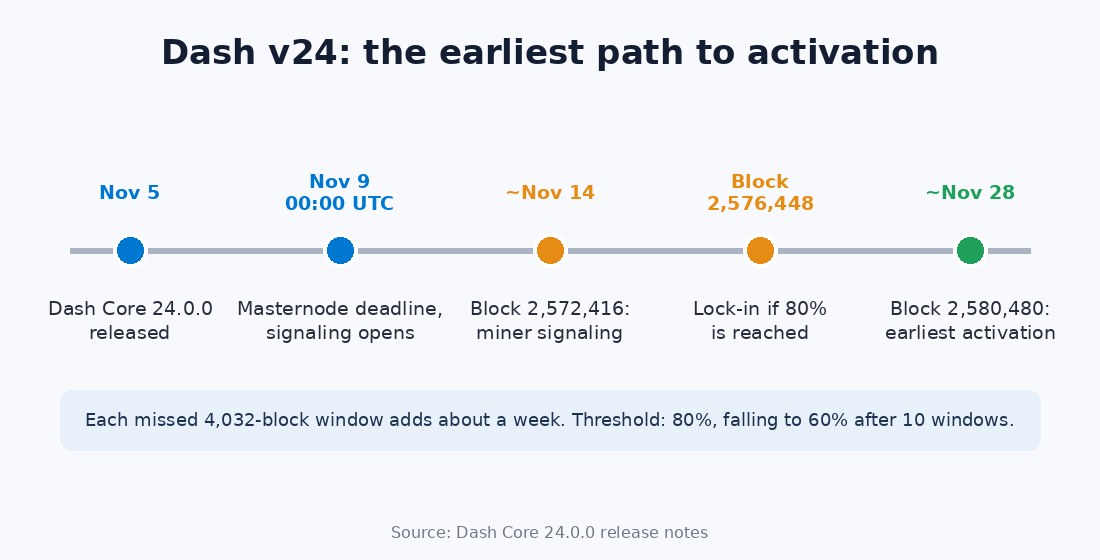
The developers expect the network to be near block 2,569,500 on 9 November. The first window boundary is block 2,572,416, around 14 November. If that window hits 80%, v24 locks in at block 2,576,448 and activates at block 2,580,480. Every window that falls short pushes activation back by about a week. These dates are estimates based on 2.5-minute blocks.
What miners and pools need to do
- Pools and solo miners running their own dashd must upgrade before activation. Nodes left on v23 will follow an invalid chain.
- Coinbase payouts change. Pools should build exactly one coinbase output for every masternode[] and superblock[] entry in getblocktemplate, in template order, even when two entries share a script or amount. After activation a block that merges them is rejected with bad-cb-payee or bad-cb-amount.
- getblocktemplate now needs a fully synced node at superblock heights.
- ASIC owners on a pool. The signal sits in the block version that the pool's node builds, so the main task is to check that your pool has announced v24 support. Dash is mined on X11 ASICs, and hashrate that stays on a lagging pool after activation risks working on the wrong chain.
Masternode pitfalls
- v24 masternodes refuse to start with some settings v23 accepted, such as -blocksonly=1, -peerblockfilters=0 or a nonzero -maxuploadtarget. This applies from the first start, not from activation.
- Masternodes still on old versions are voted bad during quorum setup and receive PoSe penalties.
- Nodes with -addressindex, -spentindex or -timestampindex migrate those indexes on first start, which can take 20 to 40 minutes or longer.
- Binaries for macOS now require macOS 14 Sonoma or later.
What else is in v24
The release adds shared masternode collateral with multi-party reward payouts, extended masternode addresses, version 2 asset locks and unlocks for Dash Platform, compact quorum proofs and descriptor wallets by default. Shared collateral for evonodes is held back: v24.0.0 does not sign the separate evo_shares signal, and the team expects a later v24.1 release to do that.