


Tari before the Ootle launch: four mining lanes and which one fits your hardware
Tari (XTM) has a date to watch. Its Layer 2, the Ootle, is confirmed for November 11, and the attention is pulling new miners to the coin. What makes Tari unusual is not the L2 but the base layer: every block reward is split between four separate mining lanes, so a CPU, a graphics card and an ASIC can all mine the same coin at the same time. Here is how the lanes work, what hardware goes where and what to check before you start.
Four lanes, 25% each
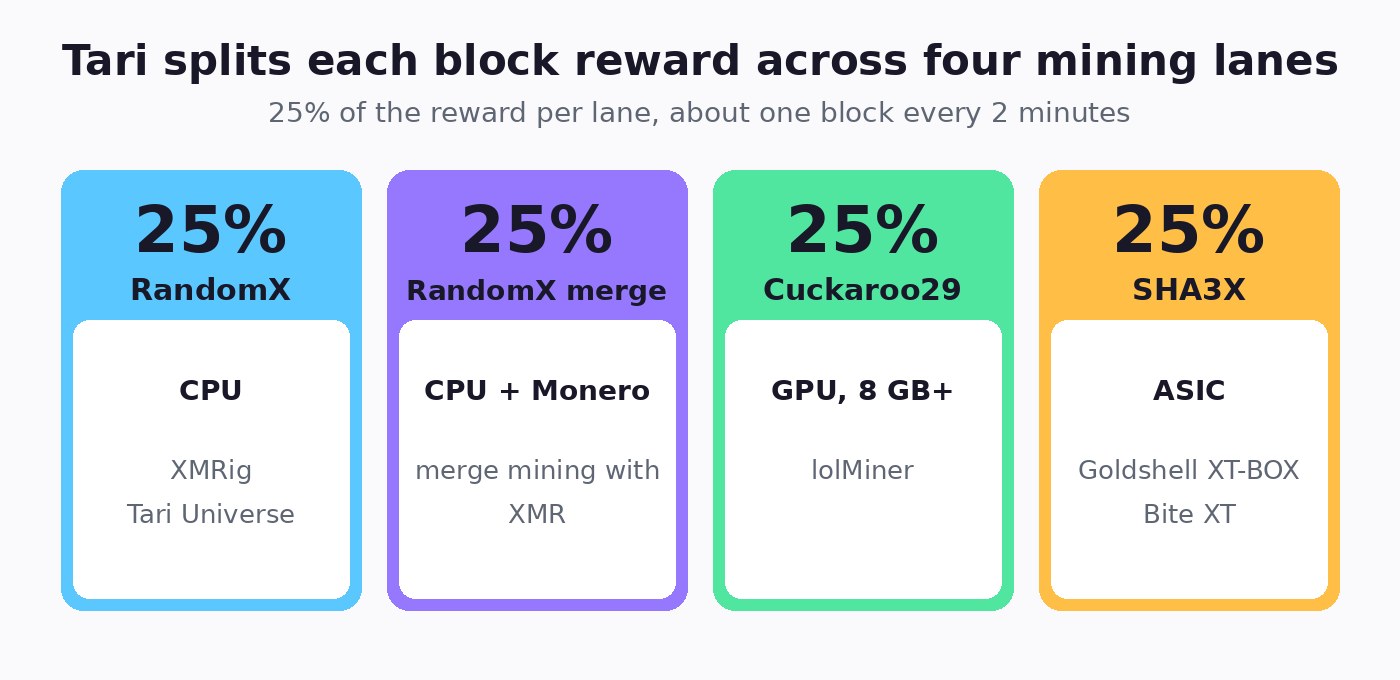
According to Bytwork's mining guide, Tari targets a block roughly every 120 seconds, and the reward is shared equally between four proof-of-work algorithms:
- RandomX solo: CPU mining for Tari RandomX (XTM-RX), with XMRig or the Tari Universe app.
- RandomX merge: merge mining together with Monero (XMR), so a CPU earns both coins without extra power.
- Cuckaroo29: GPU mining for Tari C29 (XTM-C29), typically with lolMiner. Cards need at least 8 GB of VRAM.
- SHA3x: ASIC mining for Tari SHA3X (XTM-SHA3X) on Goldshell devices such as the XT-BOX and the Bite XT.
The point of the split is security. Tari co-founder Naveen Jain explained on a podcast that an attacker would have to dominate four separate hardware markets at once instead of renting one type of hashpower. The design already had a real test: a bug once dropped difficulty on the Cuckaroo29 lane, the other lanes kept the chain running, and developers patched it with a hard fork. Since then the Tari Council has also approved an upgrade to the difficulty algorithm.
How much hardware is already on the network
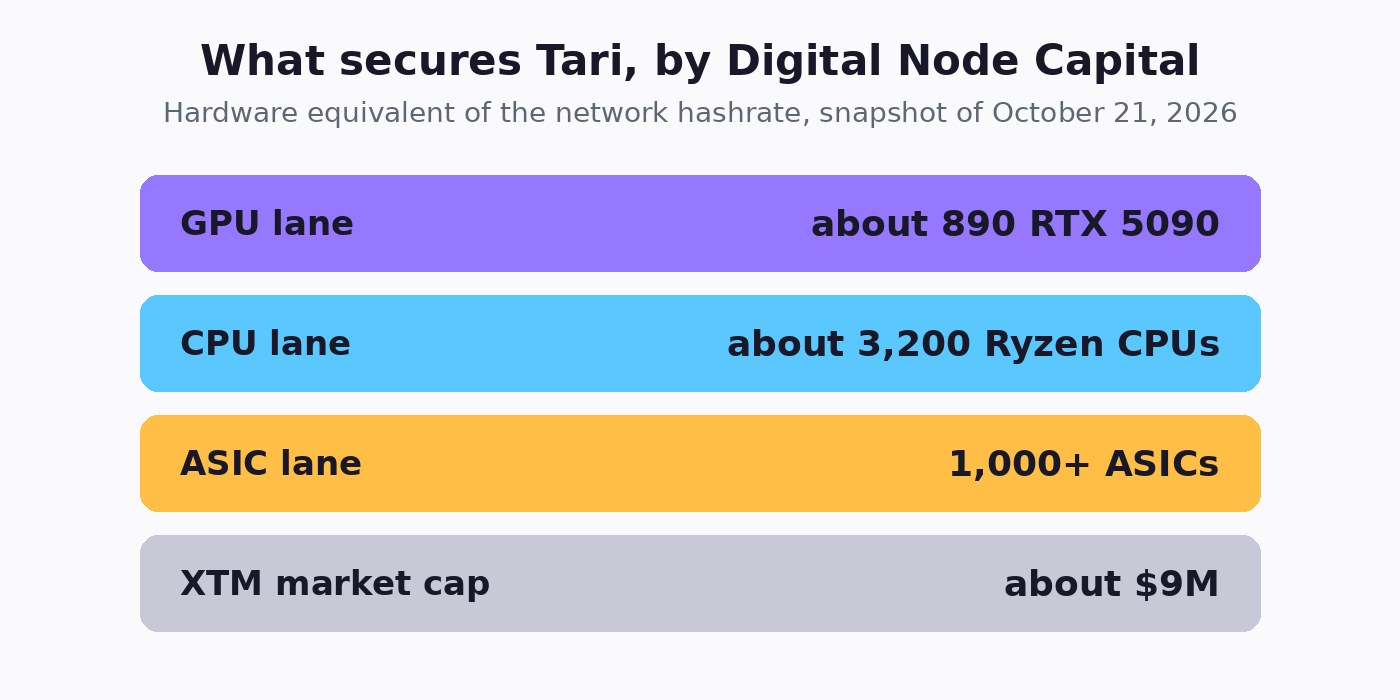
On October 21, Digital Node Capital priced up the hashrate on each lane and put it at the equivalent of about 890 RTX 5090 cards, about 3,200 Ryzen CPUs and more than 1,000 ASICs, against an XTM market cap of roughly $9 million. These are one firm's estimates, but they show that every lane already has serious competition.
What each type of hardware can expect
Bytwork's guide, updated on October 5, gives historical ranges rather than live figures. A rig of four to six RTX 3070 class cards made about $3.30 to $5.20 a day on Cuckaroo29. The Goldshell XT-BOX, which paid much more at launch, is now in the $2.50 to $5.50 a day range. On CPUs the gap is wide: an AMD EPYC 7702 made about $1.55 a day gross, a Ryzen 9 5950X about $0.55, and a 6-core Ryzen 5 5600 barely covers its electricity, while several Intel chips run at a loss. Treat these as orientation only and recalculate with today's difficulty and your own power price.
Two practical tips from the same guide: on Cuckaroo29, locking core and memory clocks cuts power draw sharply, and on 16-core CPUs such as the Ryzen 9 7950X3D, running 28 of 32 threads keeps boost clocks up and raises hashrate.
Where to point your hashrate
- Kryptex Pool: has stratum servers for all three standalone lanes (XTM-RX, XTM-C29 and XTM-SHA3X), PPS+ at about 1%, hourly payouts and an option to get paid in BTC instead of XTM.
- LuckyPool: PPLNS and solo modes at about 0.9%, and a combined Tari plus Monero mode for CPUs.
- Monero pools such as P2Pool and SupportXMR, if you want to merge mine Tari alongside XMR.
Checklist before November 11
- Update Tari Universe: version 1.6.17 came out on October 22. If you skipped the September hard fork release, the app will migrate the node database on first launch.
- Pick the lane by hardware, not by hype: CPUs on RandomX or merge mining, 8 GB+ cards on Cuckaroo29, Goldshell boxes on SHA3x.
- Check liquidity before you plan to sell: the market cap is small compared with the hardware chasing it.
- Remember that moving XTM to the Ootle means burning layer one XTM to mint layer two tokens, according to Jain. It is a one-way move.