


CloverPool quits Kaspa: where KAS miners can go as two pools control half the network
CloverPool has pulled out of Kaspa (KAS). The pool stopped its KAS mining service on October 12, and its revenue lookup for Kaspa stays open only until October 31. Meanwhile the network keeps growing, and the pools that remain are far from equal in size. Here is what CloverPool users need to do this week, how Kaspa's hashrate is split today and which ASICs still pay their power bill.
CloverPool users: act before October 31
CloverPool calls the shutdown temporary and says its other coins are not affected. For Kaspa, though, it no longer accepts hashrate, and payouts depend on one thing: a valid KAS wallet address bound to your sub-account. If you never added one, do it on the Pool Dashboard, Address page, while the revenue lookup still works. After October 31 you will have nothing left to check your earnings against.
Kaspa hashrate keeps climbing
According to KuCoin's Kaspa feed, the network climbed to about 0.38 EH/s by October 19, up from roughly 0.27 EH/s in August, though still below its April peak. Cryptohall24 put it at 369.7 PH/s on October 26, 7% more than 30 days earlier, and Kryptex Pool showed 382.08 PH/s on October 25. Cryptohall24 estimates daily issuance at 1.78 million KAS, and the reward keeps shrinking every month under Kaspa's chromatic emission schedule on the KHeavyHash algorithm.
Two pools hold more than half of the network
CloverPool was never a big player in Kaspa: a recent MiningBoard snapshot showed only about 43 TH/s on it, and the current table has no hashrate for it at all. The real story is concentration. In Cryptohall24's October 26 snapshot, humpool has 30.2% of the network and F2Pool 25.1%, which together is more than half. ViaBTC follows with 11.5%, then k1pool with 5.6% (plus another 1.1% on its solo pool), WhalePool with 3.3% and kaspa-pool.org with 2.5%. About 13% comes from unlisted pools, private farms and solo miners.
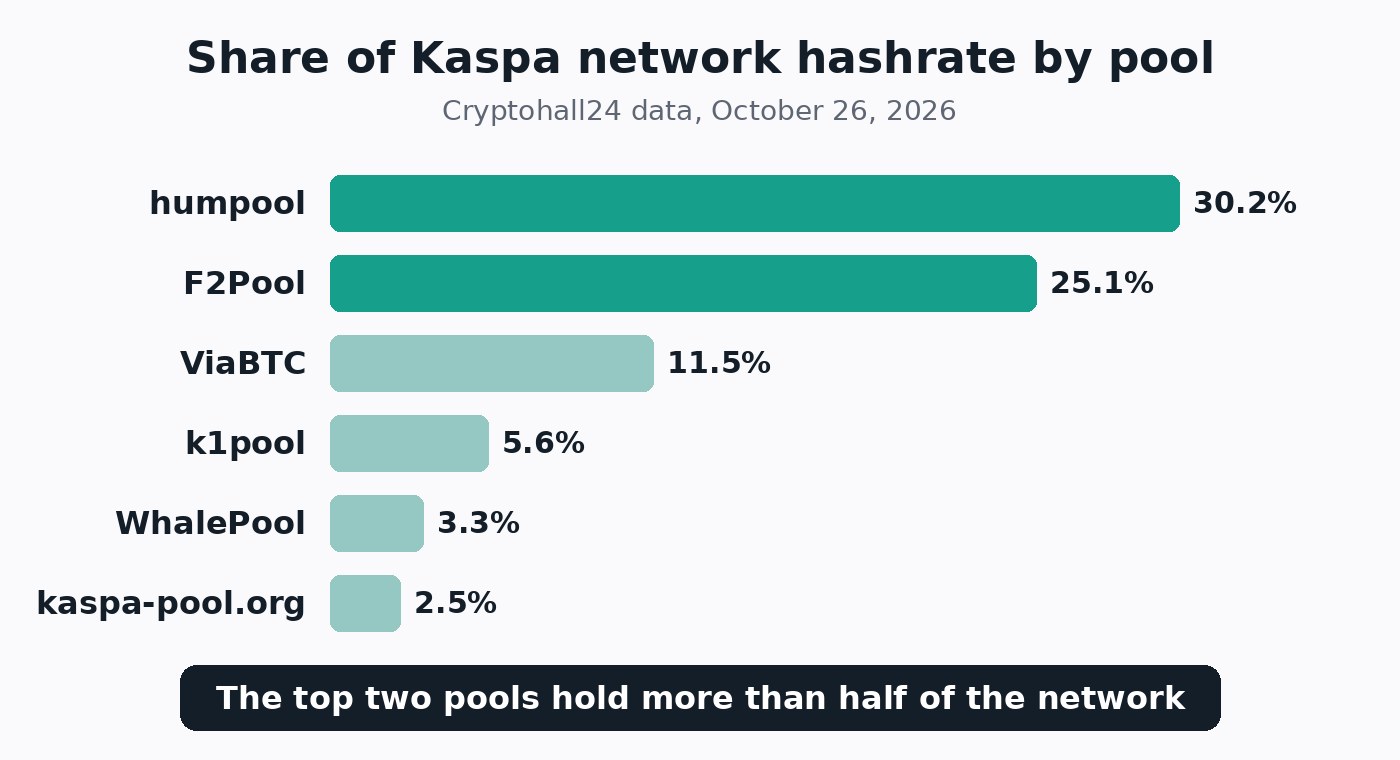
For a miner leaving CloverPool, joining the biggest pool is the easy choice, not necessarily the best one. Payouts on very large pools are smoother, but a single pool with close to a third of the hashrate is a risk for the whole network. With blocks arriving every second, a mid-sized pool finds blocks constantly too, so its luck matters much less than its fee and payout model.
Fees and payout models
- PPLNS at 1% or less: humpool and F2Pool at 1% with a 15 KAS minimum payout, k1pool at 0.5% with 30 KAS.
- PPS+ for stable income: ViaBTC charges 4% on PPS+ or 2% on PPLNS, with a 50 KAS minimum. Kryptex Pool charges 1% on PPS+ and pays out from 10 KAS.
- Small rigs: HeroMiners pays from 1 KAS at a 0.9% fee on PROP.
These figures come from Cryptohall24. Aggregators do not always agree: MiningBoard lists F2Pool and k1pool at 3%, so check the fee on the pool's own site before you switch the stratum address.
Which ASICs still make money
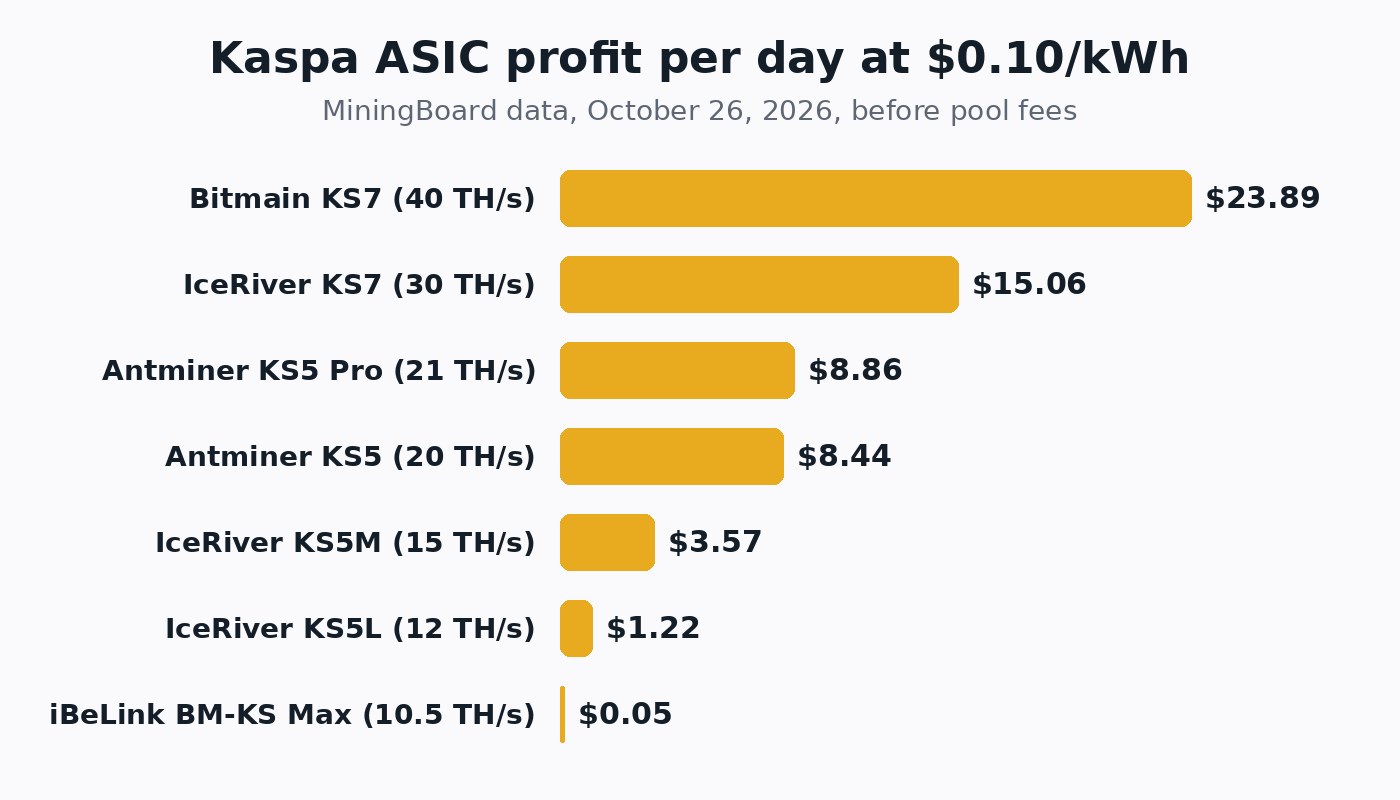
MiningBoard's October 26 table, at $0.10 per kWh and before pool fees, shows a steep drop from new to old hardware. The 40 TH/s Bitmain KS7 keeps about $23.89 a day and the IceRiver KS7 $15.06. The Antminer KS5 Pro and Antminer KS5 are around $8.86 and $8.44. The IceRiver KS5M drops to $3.57, the KS5L to $1.22, and the iBeLink BM-KS Max barely breaks even at $0.05.
A quick checklist
- Bind a KAS payout address on CloverPool and check your balance before October 31.
- Pick a pool by fee, payout model and minimum payout, not just by size.
- Use a stratum server close to you to cut rejected shares.
- Recalculate profit with your own electricity price: older ASICs are already close to zero at $0.10 per kWh.