


Zcash NU7 goes live around November 5: 25-second blocks and what miners need to change
Zcash (ZEC) is about to get its biggest change for miners in years. The NU7 network upgrade activates on mainnet at block height 3,543,405. The Zcash Foundation plans it for around November 5, and the Zakura team expects the block at about 00:50 UTC on November 6. After that, blocks arrive three times as often, part of every block's fees goes to a reserve, and nodes on old software end up on a different chain.
Blocks every 25 seconds, same daily issuance
Under ZIP 218 the target block spacing drops from 75 to 25 seconds. To keep emission unchanged, the block reward is divided by three, the remaining halving intervals are tripled and funding stream periods are adjusted to match. The four-year halving schedule and the 21 million ZEC cap stay the same.
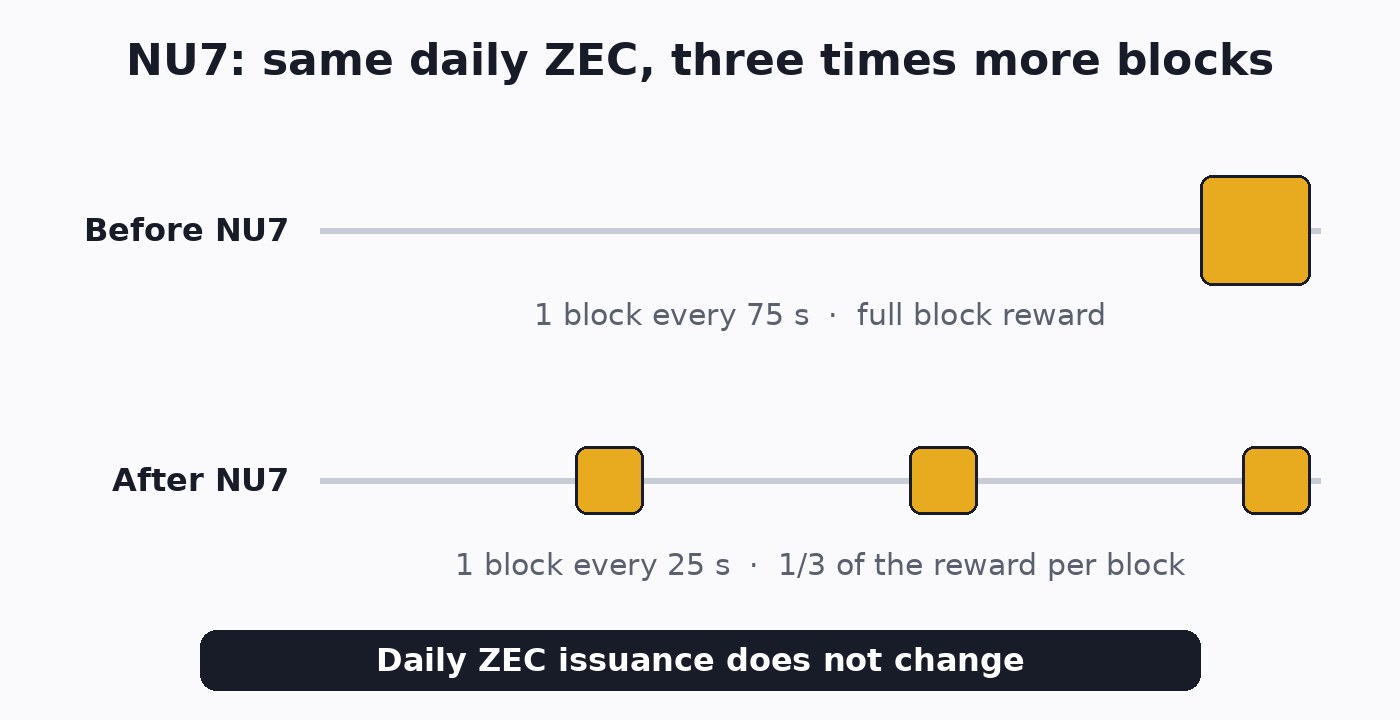
For a pool miner this means more, smaller blocks. The amount of ZEC a given hashrate earns per day should not change because of NU7 itself, but pool rounds get shorter and luck evens out faster. The release notes do not describe any change to the Equihash proof of work, so ASICs such as the Antminer Z15 Pro need no firmware swap for the upgrade. The real work falls on pools and solo miners, who run the nodes.
Miners keep 40% of transaction fees
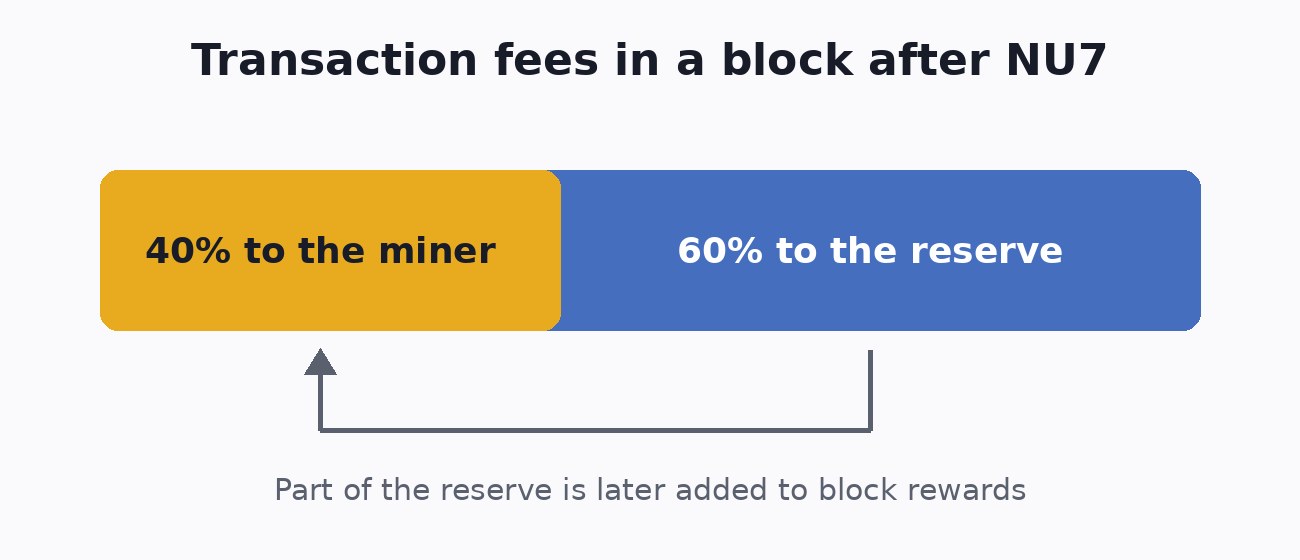
ZIP 235 removes 60% of each block's transaction fees from circulation and places them in a reserve, while the miner keeps the other 40%. Later, under ZIP 237, blocks will reissue a small, predictable portion of that reserve on top of the normal reward. On mainnet that starts at height 8,939,664, years from now. For miners the main practical change is the coinbase: it now claims only the 40% share, and pool software has to follow that.
What pools and solo miners must do
- Upgrade the node before height 3,543,405. Zebra 7.0.0 and Zakura 1.7.0 support NU7. If you run zcashd as a separate sidecar to Zakura, update it to v1.3.0. Older Zakura releases halt in the days before activation, and nodes that skip the upgrade follow a different chain.
- Do not edit block templates by hand. In Zebra 7.0.0 only time is mutable in getblocktemplate, because the coinbase commits to the fees of the chosen transactions and to the subsidy. Request a fresh template instead of changing the transaction set.
- Check your payout address. Zakura 1.7.0 removes Sapling miner rewards: a Sapling-only mining address now returns a getblocktemplate error.
- Plan the next update. Zebra 7.0.0 is supported for 8 weeks instead of 12, and Zakura 1.7.0 nodes halt at height 3,640,098, estimated for December 4.
Checklist for pool miners and holders
- Look for your pool's NU7 announcement and confirm it has upgraded its nodes before November 5.
- On activation day, watch your stale and rejected share rate and the pool's block feed. Zakura says its releases were tuned to limit the impact of faster blocks on orphan rates, but the first hours are worth checking.
- Expect payouts from more frequent, smaller blocks. Recalculate expected income only from live network data after the switch.
- Move any funds out of the old Sprout pool before activation: after NU7, version 4 transactions are invalid and Sprout funds become unspendable.
NU7 has already run on the public testnet since height 4,465,026, and the bug found there, nodes getting stuck on a losing branch during bursts of competing blocks, is fixed in Zebra 7.0.0. For miners the upgrade is mostly about timing: update before the activation block and keep an eye on the pool during the first day of 25-second blocks.