


ForgeMiner 1.9.0 puts the RX 580 and GTX 1660 back to work: what old GPUs can mine now
Two ForgeMiner releases in one week have turned it into one of the few GPU miners that cares about old cards. Version 1.8.9, published on October 22, brought AMD Radeon RX 5000 to RX 9000 support, and version 1.9.0, released early on October 28, goes further back to the Polaris generation and the GTX 16 series. Everything below comes from the official release notes on GitHub unless another source is named.
Polaris is back: RX 470 to RX 590
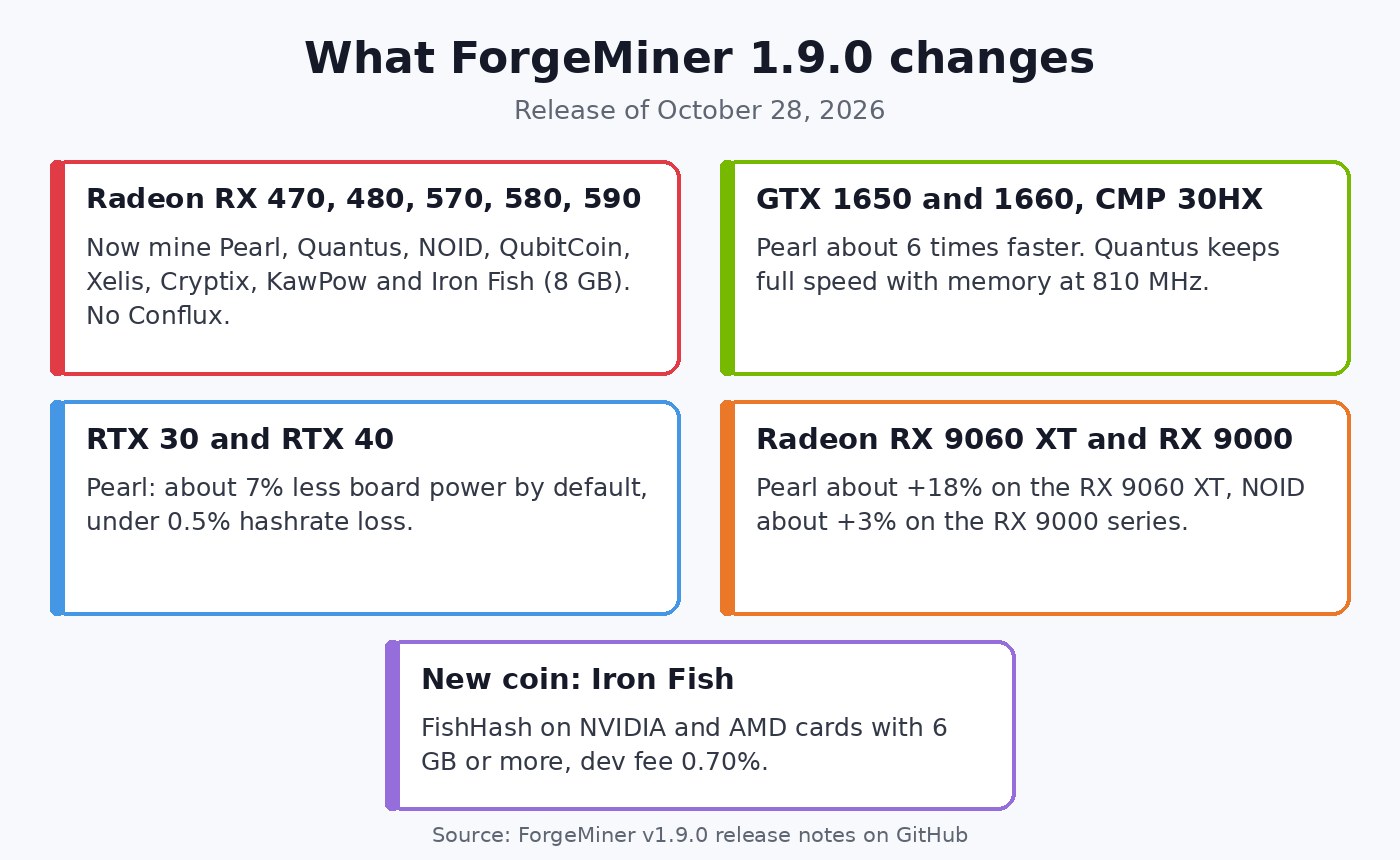
The RX 470, RX 480, RX 570, RX 580 and RX 590 now run through the stock OpenCL driver and can mine Pearl, Quantus, NOID, QubitCoin, Xelis, Cryptix and KawPow coins (Ravencoin, Quai, Neurai). Iron Fish works on the 8 GB versions. Conflux stays off the list because it needs more than 8 GB of memory, which no Polaris card has.
GTX 16 series and CMP 30HX get a real Pearl kernel
Cards like the GTX 1650 and GTX 1660 have no tensor cores, so they now use the kernel written for the GTX 10 series. The developer reports Pearl running about six times faster on the GTX 1650 and 1660 family. Quantus on GTX 16 also no longer loses half of its hashrate when memory is set to 810 MHz.
RTX 30 and RTX 40: same Pearl speed, less power
The new default Pearl kernel for RTX 30 and 40 cards draws about 7% less board power while losing under 0.5% of hashrate. The figures were measured on the RTX 3060, RTX 3070 Ti and RTX 4070 Ti. Anyone who prefers the old maximum-hashrate kernel can return to it with --kernel 2. On Linux there are also new core voltage flags: --vddc for RTX 20, 30 and 50, and --vddoff for RTX 40, checked on drivers 580, 610 and 615.
A new coin: Iron Fish on FishHash
Iron Fish is enabled with --algorithm iron on NVIDIA GTX 10 and newer and AMD RX 400 and newer. A card needs at least 6 GB, because the miner builds a 4.6 GB dataset in video memory, which takes a few seconds. The dev fee is 0.70%, the same as for KawPow. The author says speed is within a few percent of popular miners on RTX 30 and 40 and on RX 5000 to 7000, while RX 9000 is still being tuned.
Smaller gains on newer Radeons
- Pearl on the RX 9060 XT: about +18%.
- NOID on the RX 9000 series: about +3%.
- Quantus on RX 5000 to RX 9000: +1 to 1.5%.
Why version 1.8.9 matters too
Before October 22 the miner was NVIDIA-only. Release 1.8.9 added Radeon RX 5000, 6000, 7000 and 9000 for all coins on Linux, HiveOS and Windows, and lets NVIDIA and AMD cards share one process in a mixed rig. Compared with popular AMD miners, the developer claims NOID +16 to 26%, QubitCoin +5 to 7%, Pearl from +0.6% on RX 7000 to +44% on RX 5000, Quantus up to +5%, with KawPow and Conflux on par. Plain Linux needs ROCm, and Pearl on the RX 9060 XT runs only at stock voltage. SimpleMining added 1.8.9 to its OS on October 23.
Fees and alternatives
According to miner.download, ForgeMiner charges 2% on Pearl and Quantus, 1% on Xelis, 1.5% on Conflux and 0.7% on KawPow. For Pearl and Quantus there is also Krig, the miner of Kryptex Pool: it supports AMD from GCN5 to RDNA4 plus NVIDIA and takes no dev fee when you mine on Kryptex Pool (sign up for Kryptex Pool). PeakMiner 2.20.2 is another option for Quantus on RX 400/500 and RX 5000.
What to check before switching
- RTX 50 cards and NOID on RTX 30 and 40 need driver 580 or newer.
- Iron Fish needs at least 6 GB, and on Polaris only 8 GB cards are supported.
- HiveOS users can install 1.9.0 from the release archive URL listed on GitHub.
- Release notes are the developer's own measurements: compare your hashrate and wall power before and after the update.